
Wayne Dalton Garage Door Repair in Joliet: A Homeowner’s Guide
Wayne Dalton’s TorqueMaster spring hides inside the torsion bar, so a technician who has never worked on one can easily blame the opener or the cables instead of the spring itself. That misdiagnosis costs you a service call and leaves the real problem in place. If your Wayne Dalton door feels heavy, reverses on the way down, or bangs to a stop, the likely culprit is the spring system, not the motor. This guide explains how to identify what you have, what fails, and what to ask before anyone touches it. If you’d rather skip the detective work and put it in trained hands, call (855) 426-1669.
How do I know if my Joliet door has a TorqueMaster spring?
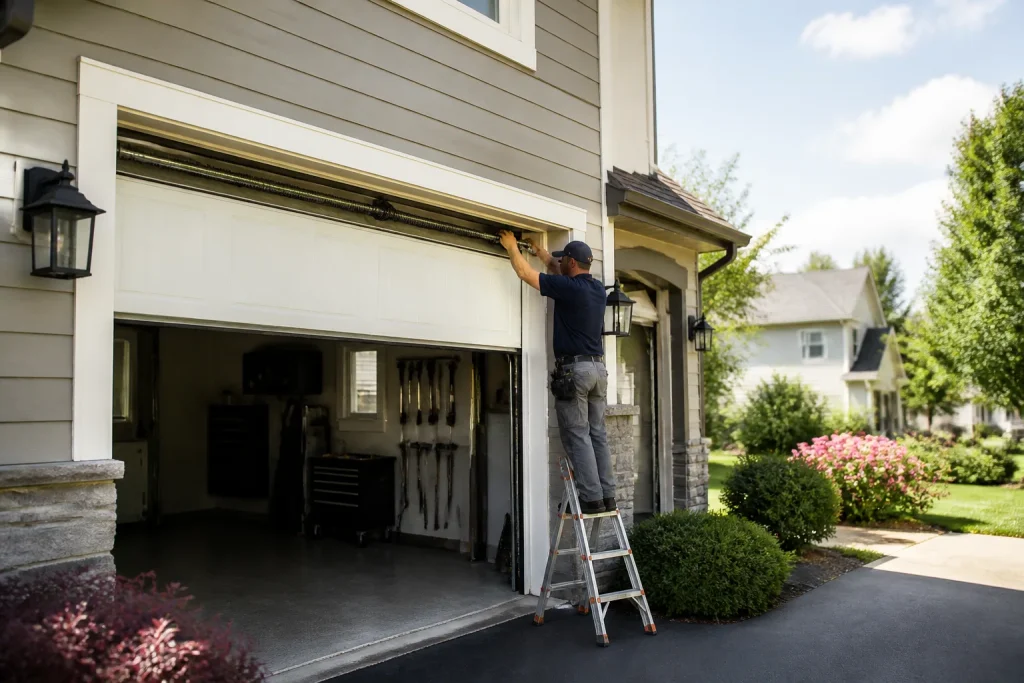
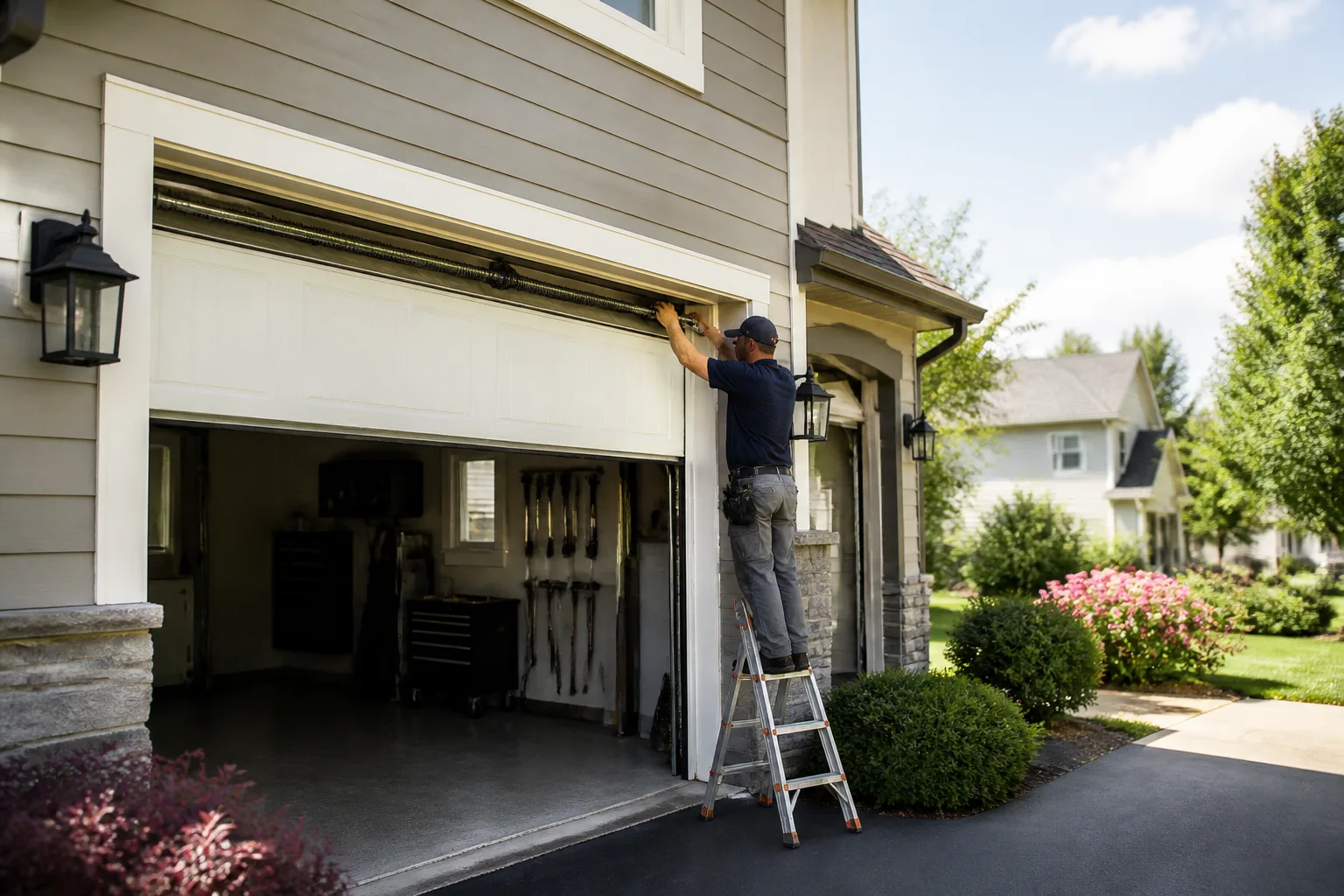
Wayne Dalton’s TorqueMaster spring sits enclosed inside the torsion bar above the door rather than mounted on the outside of it. On a standard torsion setup you’ll see one or two visible springs wrapped around a shaft above the door, with drums at each end. On a TorqueMaster door, that shaft looks like a plain tube with a winding cone or winding unit at one end and no exposed coils. If you look up and see a solid bar with nothing coiled around it, you’re probably looking at a TorqueMaster system.
There’s a second way to check without a ladder. TorqueMaster doors usually lack the two cables dropping straight down the sides to springs at the top corners. Their lift cables run along the track in a different arrangement. Many 9100 and 9700 doors sold in Joliet carry the TorqueMaster design, and it’s also common on newer 6600 steel doors.
One quick caution: don’t reach in to feel for a spring or try to wind anything by hand. TorqueMaster springs are held under high tension, and the winding unit at the bar’s end can release suddenly if it’s worn. That’s a professional’s job, not a homeowner’s.
What’s the difference between TorqueMaster and standard torsion springs?
The core difference is location. A standard torsion spring mounts outside the tube and stores energy openly. A TorqueMaster spring lives inside the tube, which keeps it cleaner and quieter but makes it invisible unless you know what you’re looking at. That invisibility is exactly why misdiagnosis happens.
Here’s how the two systems compare on the parts that matter for repair:
- Visibility: Standard springs are obvious at a glance. TorqueMaster springs are hidden and require a trained eye or a test of door weight and balance.
- Tooling: Standard springs wind with winding bars. TorqueMaster uses a winding unit and specific tools to release and re-set tension, which not every technician carries.
- Replacement: A standard torsion spring swaps out fairly simply. A TorqueMaster service often means replacing the whole torsion assembly, not just a coil.
- Noise: TorqueMaster tends to run a little quieter because the spring is enclosed, though track rollers and hinges still drive most of the noise.
None of this makes one system better than the other. It just means the repair is different, and the technician needs to know which one they’re facing before quoting the work. If you’re calling for garage door repair in Joliet, tell them up front you have a Wayne Dalton door and ask whether they’ve serviced TorqueMaster springs. That one question saves time and money.
Why does TorqueMaster replacement need special tools?
TorqueMaster springs need a winding unit to safely release and re-tension the internal spring, plus specific tools most general technicians simply don’t stock. That tooling is what keeps the stored energy in the bar from letting go all at once during the job. A technician without it will either decline the work or improvise, and improvising on a wound torsion spring is dangerous.
Before you book anyone for a Wayne Dalton door in Joliet, ask three things:
- Have you worked on TorqueMaster? Not “on garage doors generally.” Specifically on the enclosed Wayne Dalton system.
- Do you carry the winding unit and tools? If the answer is yes, you’re talking to the right place.
- Is the estimate free and written? The price should be quoted and agreed before any work starts, not revised after the spring is open.
We work on Wayne Dalton, Clopay, Amarr, and Raynor doors as a matter of course, and TorqueMaster is part of that. Our technicians have up to 13 years of experience, and the enclosed spring is not new to us. If a company’s catch-all answer is “we fix all springs,” that’s your signal to ask for more detail. A single targeted question tells you whether they know the difference.
What usually fails on Wayne Dalton doors in Joliet?
Failure patterns vary by series, and in Joliet’s freeze-and-thaw winters the steel and hardware take a real beating. Here’s what we see most across the common Wayne Dalton series:
- 9100 series (steel, insul ated): the TorqueMaster spring assembly is the usual wear point, along with hinges and rollers that stiffen in cold weather. The enclosed spring tends to fail as a unit rather than at one visible coil.
- 9700 series (premium steel): rollers and hinges wear gradually, and the winding cones can loosen over time, causing the door to bang or sag at one end.
- 6600 series (steel, common in Joliet garages): panel dents from bumped bumpers and seized rollers are frequent, and the tracks can drift out of alignment when a door gets shoved instead of lifted.
Age-related wear shows up first as weight. A door that used to lift with one hand and now feels heavy is telling you the spring has lost tension. That’s the same symptom whether the spring is exposed or hidden, which is why the balance test matters more than a visual inspection.
Can a Wayne Dalton door be repaired with new panels, or does it need replacing?
Sectional panel replacement works well when the damage is limited to one or two panels and the track and frame are still square. Wayne Dalton builds its doors with panel-only construction, so a single dented steel section can often be swapped without touching the rest of the door. That keeps the repair focused and leaves the frame and hardware alone.
Whole-door replacement becomes the sensible answer in three cases. First, when several panels are warped or the structural frame is bent or out of square, because new panels won’t sit true in a compromised frame. Second, when the TorqueMaster assembly is worn and the panels are at the end of their life too, since replacing both separately runs the cost up. Third, when the door has been hit hard enough to push the tracks out of alignment and stretch the panels.
If you’re weighing a single-panel fix against a full door, a free estimate is the fair way to decide. We’ll tell you honestly whether a section swap will hold or whether the frame has gone too far. Many Joliet homeowners wind up choosing garage door installation when the repair Math tips toward a new door, and we walk through the numbers with you before you commit.
How do I identify my Wayne Dalton model without the paperwork?
Your model is stamped or stickered on the door itself, usually on the inside of the bottom section or on the label near the end stile. Look for a series number (9100, 9700, 6600) and anything that reads like a factory or serial code. Bring a phone camera up close and photograph the label; the print is often small and faded.
If the sticker is gone, here are the next best clues:
- Look at the spring type first. If it’s enclosed in the bar, you’re almost certainly on a TorqueMaster door, which narrows the series considerably.
- Count and measure the panels. Section height and door width usually point to one series over another.
- Check the door finish. Insulated steel versus non-insulated, and the color of the steel, often distinguish the 9100 from the 6600.
- Look at the opener branding. A Wayne Dalton door paired with a LiftMaster or Genie opener gives a technician a good starting reference, since original installs often match.
Getting the model right matters because Wayne Dalton parts are model-specific. An accurate model number on the front end means a more accurate parts quote and less chance of a second trip.
Why garage door openers and Wayne Dalton doors sometimes get blamed for the same problem
A heavy or unbalanced door strains the opener, so a failing TorqueMaster spring can look like an opener fault. If your door drags, reverses, or the motor seems to struggle, the opener may be innocent. We handle garage door opener repair across LiftMaster, Chamberlain, Genie, and Craftsman units, and part of that job is confirming the door itself is balanced before we touch the motor. Diagnosing the door first saves you from replacing a perfectly good opener.
When to call a pro
Any time the door feels heavy, jerks on the way up, or bangs to a stop, it’s time to stop lifting it by hand. TorqueMaster springs and standard torsion springs store serious energy, and a homeowner shouldn’t try to wind, release, or adjust either one. The right move is a trained technician with the specific tooling for your system. We answer 24/7. Fast dispatch from 7am to 7pm, Sunday through Friday. If a door leaves your car trapped or your home unsecured, call and we’ll get it sorted. Our technicians have up to 13 years of experience, (855) 426-1669.
Related services in Joliet
If this guide points to a specific problem, we can help with Joliet Garage Door Repair Co service, garage door repair for the spring and hardware, garage door opener repair for a struggling motor, and garage door installation when a replacement makes more sense than a repair. One call covers the range.
What happens when you call
- 1
A real person answersNo phone trees – you reach a local pro.
- 2
You get an upfront price rangeHonest numbers before anyone is dispatched.
- 3
A background-checked tech heads outLicensed & insured, dispatched right away.
- 4
You approve before work beginsNothing starts until you say go.
The Bottom Line
Wayne Dalton’s TorqueMaster system is the key to a correct repair. If your Joliet door has an enclosed spring inside the torsion bar, ask any technician whether they carry the tooling for it before you book. The model number on the door itself gets you a better parts quote, and the balance test tells you more than a visual look at the spring. Sectional panels can often be swapped when the frame is sound; whole-door replacement is the right call when the frame and panels are both worn. If you’re in Joliet and need help, Joliet Garage Door Repair Co offers free estimates and works on Wayne Dalton doors alongside Raynor, Clopay, Amarr, LiftMaster, and Genie products. Call (855) 426-1669. We answer 24/7, with fast dispatch from 7am to 7pm, Sunday through Friday.
Frequently Asked Questions
Most TorqueMaster spring jobs fall in the low-to-mid hundreds of dollars in the Joliet market, but the exact price depends on the series, whether the whole assembly needs replacing, and parts availability. The estimate is free and the written price is set before any work begins, so the number you agree to is the number you pay. Call (855) 426-1669 for an exact quote.
Not reliably. TorqueMaster springs need a specific winding unit and tools that many general technicians don’t carry. Ask directly whether they’ve serviced TorqueMaster before booking, then ask if they have the tooling on hand. A vague answer to either question means it’s worth calling someone who specializes. Call (855) 426-1669 with your model and we’ll tell you what to expect.
It shouldn’t. We quote and agree the price before work starts, and that written estimate is what you pay. A technician who only ever quotes by phone without seeing the door may need to adjust the estimate, which is another reason to get a free on-site measure first. Call (855) 426-1669 to book one.
The local pros we connect you with are licensed and insured as their state requires, and their work is backed by a satisfaction guarantee. Our technicians have up to 13 years of experience and work on whatever brand is in your garage, including Wayne Dalton, Raynor, and LiftMaster systems. Call (855) 426-1669 for a free estimate and we’ll match you with the right professional.
Written by the team at Joliet Garage Door Repair Co.
Need Garage Door Help?
Call Joliet Garage Door Repair Co - the local pro we connect you with is licensed and insured, here with fast help in Joliet.
(855) 426-1669